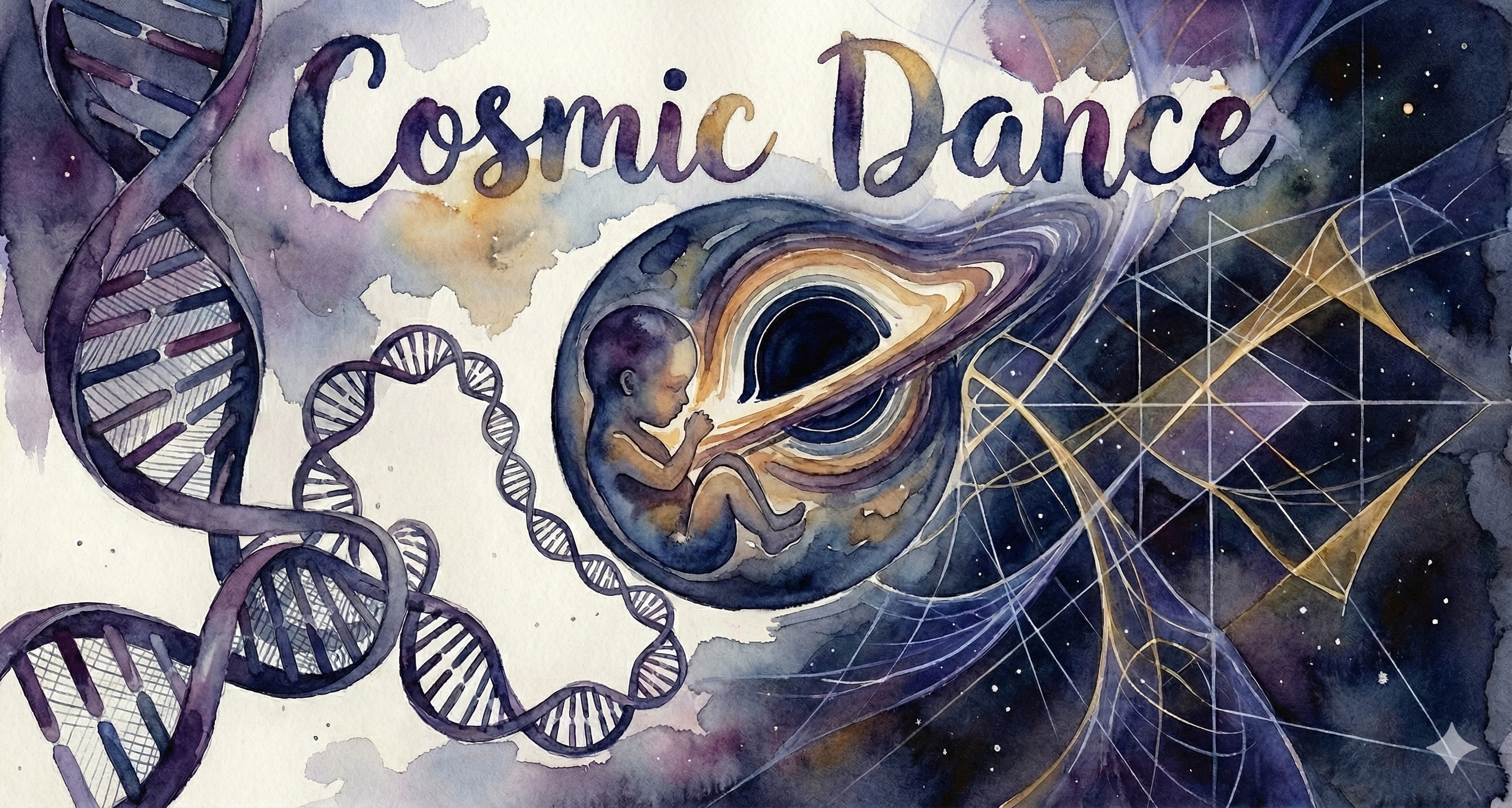
पुनरपि जननं पुनरपि मरणं
पुनरपि जननी जठरे शयनम् ।
इह संसारे बहुदुस्तारे
कृपयापारे पाहि मुरारे ॥
(Punarapi jananam punarapi maraṇam
Punarapi jananī jaṭhare śayanam |
Iha saṃsāre bahudustāre
Kṛpayāpāre pāhi murāre ||)
"Again birth, again death. Again lying in the mother's womb.
This ocean of existence is vast and hard to cross —
O Murari, save me with your boundless grace."
~ Adi Shankaracharya, Bhaja Govindam
Life, where the frame of reference matters most. We understand — or don't — differently at each phase. At times things feel like cruising, and sometimes like a quantum jump. It is when we watch our past as audience that something hits us. Or makes us ask.
How did we reach here?
And where is all of this going?
I.
The second law of thermodynamics is perhaps the most undefeated law in all of physics: entropy increases, disorder wins.
And yet — life seems to have missed the memo. Consider the arc of a single human existence. We arrive into a world of remarkable simplicity — a face, a voice, warmth — and watch it accumulate, year by year, into something bewilderingly complex. A song crackling over a radio becomes a library of a million songs in our pocket. A corner store becomes an aisle of a dozen varieties of soap. The world outside grows louder, busier, more layered.
And yet the body, quietly, moves in the opposite direction. The bursting energy of youth softens. Mornings require negotiation. The horizon has inertia written on it. Everything outside tends toward complexity. Everything inside tends toward equilibrium. Both obeying the same law — from different sides of it.
A human body doesn't drift toward chaos — it actively resists it, pulling energy from its surroundings to build and maintain structure. Schrödinger had a name for this: negative entropy. Life feeds on negentropy the way a flame feeds on oxygen. The organism is not exempt from the second law — it simply borrows order from the environment around it, leaving the universe slightly more disordered in exchange for its own improbable coherence.
Every living thing is a quiet rebellion.
But the smaller the system, the less this orderly behavior can be taken for granted. Schrödinger observed that physical laws derive their precision from the sheer number of atoms involved — the more particles, the more predictable the aggregate.
A crowd follows statistics. An individual does not.
At the scale of the molecules inside a cell — the atoms dancing inside a strand of DNA — the numbers are small enough that randomness is not the exception. And yet here we are. Warm, ordered, improbably complex.
Isolated, life looks like defiance. In context, it is participation. The circle, it turns out, was always complete.
II.
The universe, it turns out, has been at this far longer than us.
Our own earth also went through adolescence and teenage. The sky was not blue. The oceans were not calm. Meteorites fell without apology. Volcanoes rewrote the landscape daily. By any reasonable measure, this was a universe practicing its favorite habit — disorder, on a grand scale.
As time went by. Somewhere in the chaos, a molecule folded onto itself for the first time. Delicate. Precise. Alive, in the most primitive sense of the word.
RNA, that first fragile messenger, emerging not despite the violence around it but somehow within it. The universe was not being careful. Life was.
Order from chaos. A pattern so stubborn it appears to run in both directions — forward into complexity, and backward into silence. This boom and bust appears to be everywhere. Perhaps more than once. If the cosmologists who speak of a Big Bounce are right — an infinite cycle of contractions and expansions — then this has all happened before.
Punarapi jananam; Again and again, the universe exhales into complexity before the long inhale back to silence.
Adi Shankaracharya might have felt this. He didn't have the equations. But the intuition that existence is not a line but a tide.
III.
Piercing inside that tide, something even stranger is happening.
At the very beginning of a human life — before the embryo is an embryo, before the cell is anything more than a question — the relevant actors are not organs or systems. They are molecules and atoms. Particles small enough that the comfortable laws of Newton do not yet apply.
The smaller the ensemble of particles, the wilder their individual behavior. And it is precisely here, in this brief window of molecular uncertainty, that the DNA receives its instructions. A set of chemical combinations assembled under conditions of genuine quantum fuzziness.
Our genome is, in part, a record of decisions made in the dark.
Then mitosis begins. The cell divides. And divides again. The ensemble grows — from molecules to cells to tissues to organs — and as it grows, something shifts. The quantum noise averages out. The system gains mass, gains predictability, gains the dignified obedience of classical physics. Our heart does not beat according to probability distributions. Our bones do not occupy multiple positions simultaneously.
Newtonian physics reasserts itself, firmly, and the organism that emerges is one that can be located, measured, predicted. The equation of life gets embedded.
Which raises the question that science approaches carefully and philosophy refuses to let go: if our deepest biological instructions were written during a period of irreducible uncertainty — is that destiny? Or is it something more unsettling — a destiny that was never quite fixed?
IV.
Perhaps the universe has only ever known one trick. To its credit — it performs it rather well.
Take the amino acids that fold into proteins. The specific sequence of ingredients and its arrangement determines everything. A protein misfolded is not a minor variation. It is a different thing entirely. The same 20 amino acids, rearranged, produce silk or venom or the lens of an eye. Twenty characters. Infinite vocabulary.
Scale up. The same logic holds. Hydrogen and helium, arranged one way, become a star. Arranged another, a gas giant. A different density, a different moment in the cooling of a nebula, and we get a planet with liquid water and a warm tidal pool — and eventually, someone drifted far along in thought questioning their own existence.
The universe is not simply random. It is a vast, patient experiment in arrangement — running every possible configuration across every possible scale, from the amino acid to the galaxy cluster, feeling out which combinations hold. Wave function with positive probability.
We are one of the combinations that held. The holding, it turns out, was never stillness.
The dance happening inside every cell is a quieter version of the dance that formed the cosmos. We are not in the universe the way a stone is in a field. We are the universe — arranged, for now, in this particular and improbable way.
Punarapi jananam. Punarapi maranam. Again and again. The Nruthyam continues.
This piece was shaped by years of wandering in thoughts and around the world — and six books that refused to leave my thinking: Erwin Schrödinger's What is Life? (1944), Charles S. Cockell's The Equation of Life, Sean Carroll's Something Deeply Hidden, Brian Greene's The Fabric of the Cosmos, Thomas R. Cech's The Catalyst, and Michio Kaku's Quantum Supremacy. The conclusions, and the questions, are my own.